AI Engineering
Enterprise Knowledge Assistant using RAG & LLMs
AI Lab
AI-powered enterprise knowledge assistant combining large language models, retrieval-augmented generation, vector search, and prompt engineering to provide grounded answers from organizational knowledge.
Overview
An AI-powered knowledge assistant designed to demonstrate how enterprise organizational knowledge can be made accessible through natural-language interaction.
The solution combines large language models with retrieval-augmented generation (RAG) so that responses can be grounded in relevant knowledge rather than relying solely on the model’s general training.
Problem
Traditional enterprise knowledge is often distributed across documents, applications, and information repositories.
Finding the right information can require users to search through multiple sources manually.
The goal of the AI assistant is to provide a natural-language interface for retrieving relevant organizational knowledge while maintaining control over the information used to generate responses.
Solution
The solution uses a retrieval-augmented generation architecture.
Enterprise knowledge is processed and transformed into searchable representations. User questions are then used to retrieve relevant context, which is provided to the language model as part of the generation process.
The overall approach separates knowledge retrieval from response generation.
RAG Pipeline
The conceptual pipeline consists of:
- Knowledge ingestion
- Document processing
- Text chunking
- Embedding generation
- Vector indexing
- Semantic retrieval
- Context construction
- Prompt engineering
- LLM response generation
- Response evaluation
Architecture
The solution follows a retrieval-augmented generation architecture that separates knowledge ingestion and indexing from real-time question answering.
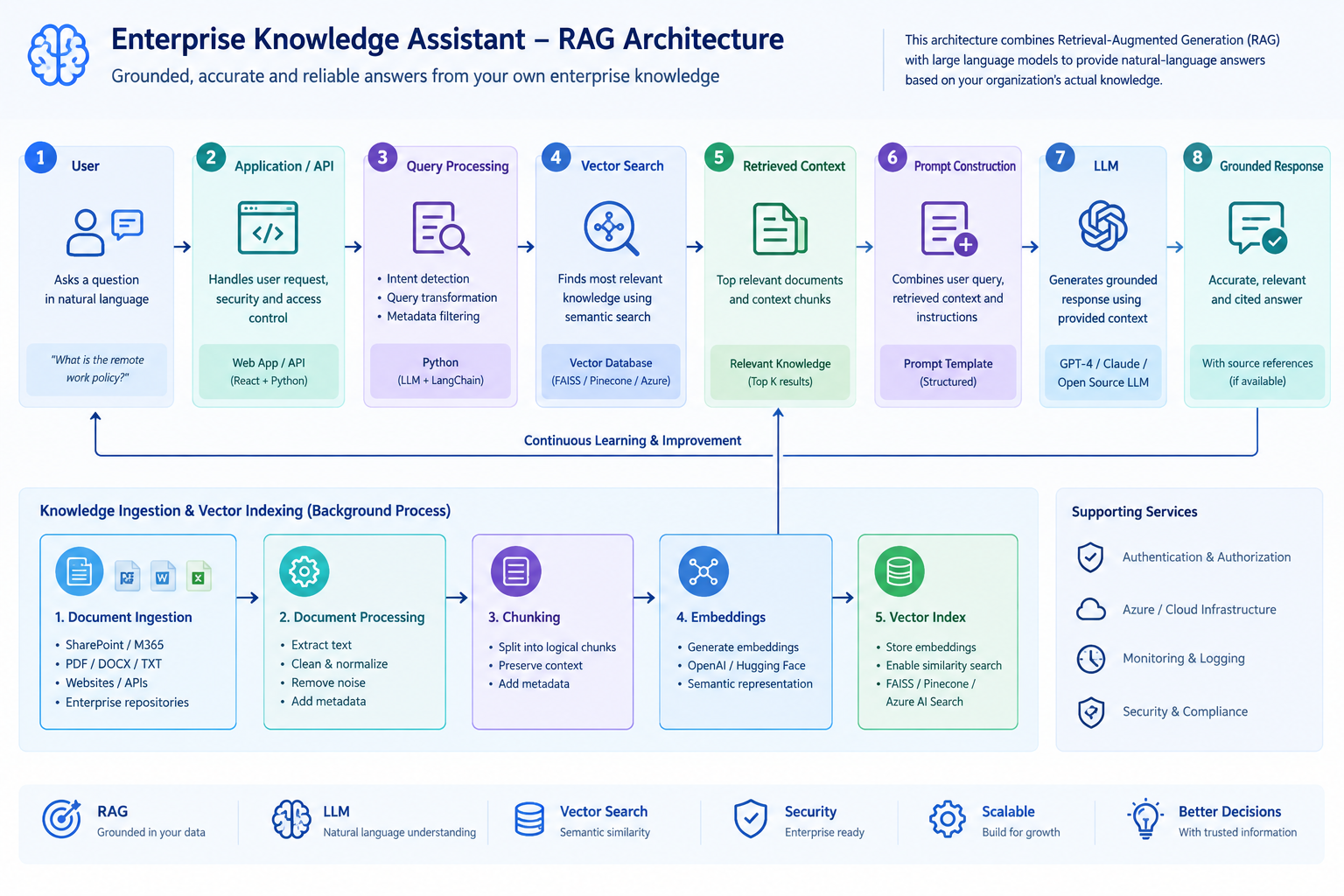
The architecture consists of two primary flows:
Knowledge Ingestion Flow
Enterprise documents are collected from sources such as SharePoint, Microsoft 365, PDFs, websites, APIs, and other repositories. Content is processed, cleaned, divided into logical chunks, enriched with metadata, converted into embeddings, and stored in a vector index.
Question Answering Flow
When a user submits a question, the application processes the query and performs semantic retrieval against the vector index. The most relevant content is then assembled into context and supplied to the LLM through a structured prompt.
The generated response is grounded in the retrieved enterprise knowledge rather than relying exclusively on the model’s general knowledge.
Key Architecture Principles
- Separation of retrieval and generation — knowledge retrieval is handled independently from response generation.
- Grounded responses — retrieved content provides the context used by the LLM.
- Semantic search — vector representations enable similarity-based knowledge retrieval.
- Metadata-aware processing — document metadata can be used to improve filtering and retrieval.
- Enterprise security — authentication, authorization, and access controls can be applied around enterprise knowledge.
- Extensibility — the architecture can evolve to support different LLMs, vector databases, enterprise repositories, and evaluation strategies.
Engineering Focus
- Retrieval-augmented generation
- Large language model integration
- Vector search
- Semantic retrieval
- Prompt engineering
- Document processing
- Knowledge ingestion
- AI-powered enterprise automation
- Python-based AI development
- OpenAI and Hugging Face integration
Retrieval Strategy
The retrieval layer is responsible for identifying the most relevant knowledge for a user’s question before the language model generates the response.
This approach helps reduce dependence on the model’s general knowledge and provides a mechanism for grounding responses in the organization’s available information.
Prompt Design
Prompt engineering is used to define how retrieved context is provided to the language model and how the model should construct its response.
The prompt strategy focuses on producing useful responses while keeping the generated answer aligned with the retrieved knowledge.
Evaluation
Evaluation should consider both retrieval quality and answer quality.
Important areas include:
- Relevance of retrieved content
- Accuracy of generated responses
- Grounding in retrieved context
- Completeness of answers
- Handling of questions with insufficient information
- Consistency of responses
Challenges
Enterprise AI systems introduce several engineering challenges, including retrieval quality, context selection, prompt design, hallucination control, and evaluation of generated responses.
A reliable implementation therefore requires attention to both the retrieval pipeline and the language-model layer rather than treating the LLM as a standalone component.
Lessons Learned
RAG-based systems require careful engineering across the complete pipeline.
The quality of the final response depends not only on the language model but also on document preparation, chunking, embeddings, retrieval strategy, context construction, and prompt design.
Future Improvements
Potential improvements include:
- Hybrid keyword and semantic retrieval
- Improved chunking strategies
- Reranking retrieved results
- Metadata-aware retrieval
- Automated evaluation datasets
- Response quality monitoring
- Access-controlled enterprise knowledge
- Integration with Microsoft 365 and enterprise repositories
Architecture
The portfolio version of this project will present the architecture using synthetic or non-confidential data so that the engineering approach can be demonstrated without exposing proprietary enterprise information.